Why AI Email Marketing Is Moving From Tools to Autonomous Agents
- marketingworksbudd

- Jun 1
- 7 min read
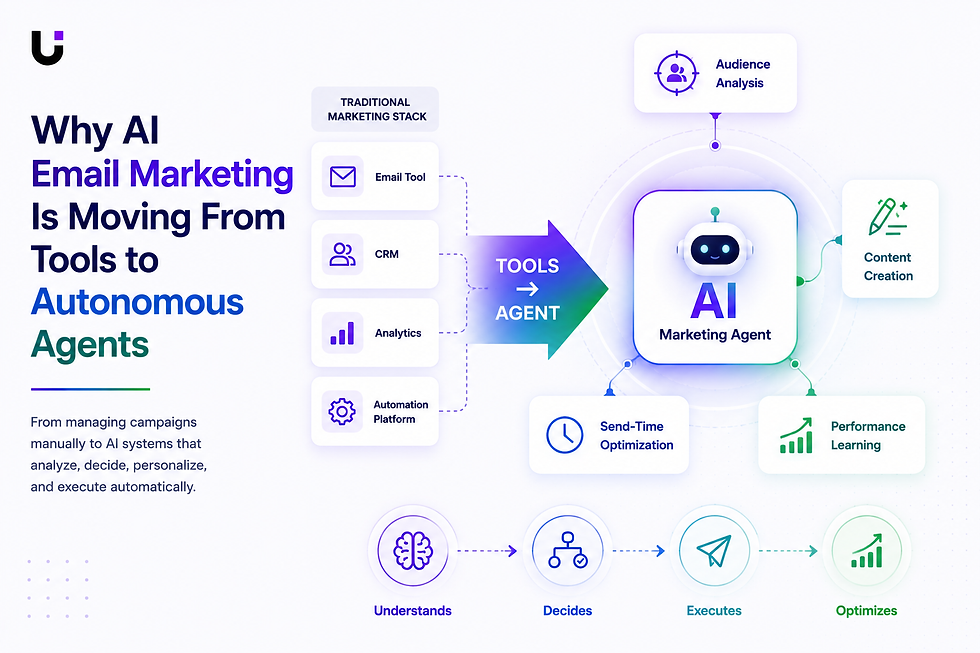
For the past decade, AI in email marketing meant smarter tools. Better subject line suggestions. Improved send time predictions. More sophisticated segmentation logic. Marginally better open rate optimization built into platforms that still fundamentally required humans to operate them.
That era is ending.
The shift happening right now in AI email marketing is not an incremental improvement in tool capability. It is a categorical change in what AI actually does inside an email marketing operation. The industry is moving from AI-assisted tools that make human marketers more efficient to AI employees that own the email function end to end, executing strategy, adapting to results, managing relationships, and optimizing performance without waiting for a human to review a dashboard and decide what to do next.
For businesses that understand this shift and position themselves on the right side of it, the competitive implications are enormous. For those still thinking about AI as a feature inside their existing email platform, the gap is growing faster than it appears.
The Fundamental Limitation of AI Marketing Tools
To understand where AI email marketing is going, it helps to be precise about where it has been and why that approach always had a ceiling.
AI marketing tools enhanced human decision-making. They analyzed data and surfaced insights. They generated content options for humans to choose between. They predicted outcomes and flagged opportunities. But the execution chain still ran through people. A human had to review the insight, make a decision, build the campaign, set the parameters, approve the send, and monitor the results. AI was the advisor. The human was the operator.
This created a structural bottleneck that no amount of tool improvement could resolve. The speed of your email marketing operation was ultimately constrained by the speed of human review and approval at every step. Your personalization was limited to what a human could configure in the segmentation interface. Your responsiveness to behavioral signals was limited to how often someone had time to check the analytics and act on what they saw.
For small businesses and scaling teams without dedicated email marketing staff, this bottleneck was even more pronounced. AI tools that required significant human operation to realize their value were only as useful as the time available to operate them, and that time was almost never sufficient.
AI employees solve this at the root.
What AI Employees Actually Mean for Email Marketing
The term AI employees is not marketing language. It describes a genuine functional shift in how AI operates within a business.
A traditional AI marketing tool waits for instructions. An AI employee holds a function. It owns an outcome, monitors everything relevant to that outcome continuously, makes decisions independently within defined parameters, executes those decisions without requiring approval for routine actions, and escalates only when genuinely novel judgment is required.
Applied to email marketing, this is what that looks like in practice:
Autonomous campaign management. An AI employee does not wait for a human to build and schedule a campaign. It identifies the right audience segment based on current behavioral data, generates the content calibrated to that segment's engagement history, determines the optimal send time for each individual contact, executes the send, and begins monitoring results immediately. The human sets the strategic objective. The AI employee handles every execution decision required to pursue it.
Continuous relationship management. Every contact in your database has a relationship trajectory. Some are warming up toward a purchase decision. Some are drifting toward disengagement. Some have just converted and need onboarding. An AI employee tracks every trajectory simultaneously, adjusting the communication strategy for each contact in real time based on what their behavior is signaling. This is not segmentation. It is individual relationship management at a scale no human team could sustain.
Self-optimizing sequences. When an AI employee runs an email sequence and sees that a particular subject line is underperforming with a specific audience cohort, it does not wait for a human to notice the open rate drop and schedule a review meeting. It tests alternatives, identifies what works better, updates the sequence, and continues optimizing. The performance improvement loop runs continuously and automatically.
Proactive outreach decisions. An AI employee does not just respond to triggers you have predefined. It identifies patterns in contact behavior that signal opportunity and initiates outreach autonomously. A contact who visited your pricing page three times in a week but has not received a follow-up gets one, not because a rule was set up for that exact scenario but because the AI recognized the signal and acted on it.
Why This Shift Is Happening Now
The move from AI marketing tools to AI employees is not accidental. It is the result of three converging developments that have reached a tipping point simultaneously.
The first is the maturation of large language models to the point where AI can generate email content that is genuinely persuasive, contextually appropriate, and indistinguishable in quality from what a skilled human copywriter would produce. Content generation is no longer a constraint on autonomous operation.
The second is the availability of behavioral data infrastructure that gives AI employees the real-time signal they need to make good decisions. Modern email platforms collect rich engagement data at the individual contact level. Combined with website behavior, CRM activity, and purchase history, AI employees have enough signal to make genuinely intelligent decisions about what to send to whom and when.
The third is the integration of AI agents into connected business platforms rather than standalone tools. An AI employee operating inside a platform that connects email to sales pipeline, project management, invoicing, and client communication has context that a standalone email tool never had. It knows that a contact just signed a contract. It knows that a project milestone was just completed. It knows that a payment is overdue. It uses that context to send communication that is relevant to what is actually happening in the business relationship, not just what the email sequence says should come next.
The Business Case for AI Employees Over AI Tools
The ROI calculation for AI employees in email marketing is different from the ROI calculation for AI tools, and the difference matters.
AI tools deliver efficiency gains. They reduce the time a human marketer spends on a task. The value is real but it is proportional to how much human time you had invested in that task to begin with. For a large marketing team running high-volume campaigns, the time savings are significant. For a small business where the founder is doing email marketing between client calls, the efficiency gain from a slightly smarter tool is marginal.
AI employees deliver capacity gains. They do not just make existing work faster. They do work that was not being done at all because there was no one available to do it. Every follow-up that was not being sent because no one had time to set up the sequence, every re-engagement campaign that never got built because it was not the priority this quarter, every relationship that drifted cold because no one was watching the engagement signals closely enough, an AI employee handles all of it continuously without the capacity constraint that limited what was possible before.
For small businesses especially, this distinction is transformational. An AI employee in email marketing does not augment a marketing team. For businesses that do not have a marketing team, it becomes one.

How WorksBuddy Evox Operates as an AI Email Employee
Evox is WorksBuddy's AI communication agent and it was built from the ground up around the AI employee model rather than the tool model.
Evox does not sit inside your email platform waiting to be configured. It holds your communication function. When a lead enters your pipeline through Lio, Evox initiates a personalized outreach sequence calibrated to where that lead came from and what they engaged with, without anyone building the sequence manually. As the lead progresses, Evox reads every behavioral signal and adjusts its approach in real time, accelerating follow-up when engagement is strong and shifting to a re-engagement strategy when signals cool.
For existing clients, Evox manages the entire ongoing communication relationship. Project updates go out when Taro marks milestones complete. Invoice reminders go out when Inzo generates billing. Check-in emails land at the right moment in the client lifecycle based on relationship signals, not a fixed calendar. Every communication is connected to what is actually happening in the business relationship rather than running on a generic schedule that ignores context.
When Evox identifies a contact whose engagement pattern suggests they are approaching a renewal or upsell decision, it initiates the relevant outreach autonomously and routes the conversation to the right team member when human judgment is needed to close. The handoff from AI employee to human happens at exactly the right moment, not before and not after.
What This Means for How You Staff and Scale
The emergence of AI employees in email marketing has practical implications for how businesses think about building their teams and their operations going forward.
The question is no longer how many people you need to run your email marketing function. It is what level of strategic direction and relationship judgment you need humans to provide, and what level of execution you can confidently delegate to an AI employee that will handle it more consistently, more continuously, and at greater scale than a human team could sustain.
For most small businesses and scaling teams, the answer is that a significant portion of the email marketing execution layer can be handled by AI employees right now. Campaign management, sequence optimization, behavioral follow-up, re-engagement, relationship touchpoints, and performance reporting can all run autonomously. The human role becomes setting strategy, reviewing results, making judgment calls on complex relationship situations, and directing the AI employee toward new objectives as the business evolves.
This is not a future scenario. It is available today for businesses that choose to build on the right platform.
The Bottom Line
AI email marketing is not getting better tools. It is getting AI employees that own the function, execute autonomously, and deliver results that no tool dependent on human operation could match at scale.
The businesses that recognize this shift and build their email marketing around AI employees rather than AI-assisted tools are not just improving their campaign performance. They are fundamentally changing the economics of what it takes to run a high-performing email marketing operation, removing the human capacity constraint that has always been the ceiling on what email can deliver.
WorksBuddy Evox is that AI employee for your email and communication function, built into a platform where every signal from across your business informs every communication decision it makes.
See how Evox operates as your AI email employee at worksbuddy.ai/evox


Comments