How WorksBuddy Replaces Your Entire Business Tool Stack with AI Agents
- marketingworksbudd

- May 25
- 6 min read
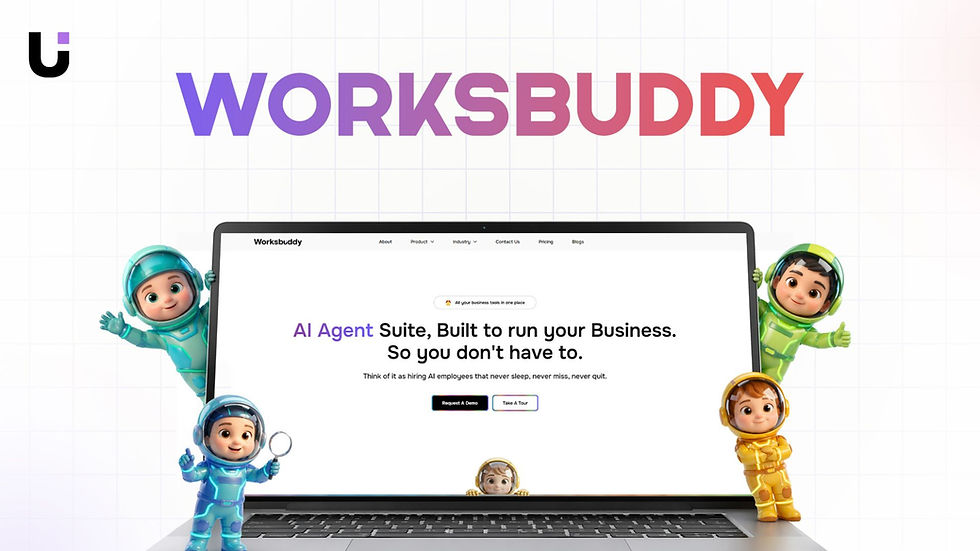
Most growing businesses are running on too many tools. A CRM for leads, a project management tool for tasks, an invoicing platform for billing, a separate e-signature tool for contracts, an email marketing platform for campaigns, and a workflow automation tool to connect everything that refuses to talk to each other.
The average business uses over 100 SaaS applications. And nearly 87% of paid seats across those tools go underused every month. That is not a people problem. That is a model problem.
WorksBuddy was built to fix it.
The Problem with Stacking Tools
Every tool you add to your stack creates a new gap. Data lives in silos. Your sales team updates the CRM but finance never sees it. A contract gets signed but someone still has to manually create the invoice. A project reaches a milestone but the client never gets notified because the task tool and the email tool do not talk to each other.
The result is that your team spends more time managing the connections between tools than doing the actual work those tools are supposed to support. Research shows that knowledge workers spend up to 60% of their time on work about work — status updates, data entry, manual handoffs, and tool switching.
WorksBuddy removes those gaps entirely by replacing the stack with a connected platform where every agent shares the same data layer and every action in one agent can trigger an automatic response in another.
What WorksBuddy Actually Is
WorksBuddy is an AI agent platform. It is not a single tool with an AI feature attached. It is a collection of purpose-built AI agents, each designed to handle a specific business function, all connected in one unified platform.
Each agent operates independently for its own function and automatically in coordination with the others. When something happens in one agent, the rest respond without anyone having to manually connect the dots.
Here is what that looks like in practice across each agent.
LIO: Lead Management and CRM
LIO replaces your CRM. It captures incoming leads, scores them using AI-powered intent signals and behavioral data, qualifies them against your ideal customer profile, and surfaces the highest-priority prospects for your sales team every morning.
Instead of a rep logging into the CRM to manually update records, score leads, and decide who to call next, LIO handles all of that automatically. The rep shows up to the conversation, not the administration.
LIO also enriches contact profiles using LinkedIn data, detects buying signals in real time, and tracks every deal through a customizable sales pipeline. When a deal closes in LIO, the rest of the platform responds automatically.
Taro: Task and Project Management
Taro replaces your project management tool. It handles task creation, sprint planning, Kanban boards, Gantt timelines, task dependencies, time tracking, and workload distribution in one workspace.
What makes Taro different from a standard project management tool is the AI layer. Taro uses AI risk prediction to flag projects that are heading toward a missed deadline before anyone has to ask. It analyses team capacity and recommends exact task reassignments when someone is overloaded. It surfaces blockers by project phase before they delay the whole team.
Project managers stop compiling status updates and start making decisions based on intelligence Taro surfaces automatically.
Inzo: Invoicing and Billing
Inzo replaces your invoicing and billing platform. It generates invoices automatically based on configured triggers, sends smart payment reminders on an escalating schedule, tracks accounts receivable in real time, and forecasts cash flow so finance teams see problems before they become crises.
The most powerful part of Inzo is how it connects to the rest of the platform. When Sigi receives a completed contract signature, Inzo automatically generates the corresponding invoice. No one has to manually create it. No step gets missed because someone forgot to check a notification.
Sigi: E-Signatures and Contract Management
Sigi replaces your e-signature tool. It manages the full document signing workflow — sequential signing, parallel signing, approval workflows, and self-signing — with AI contract risk analysis and immutable audit trails built in.
Before a contract is sent, Sigi's AI clause intelligence reviews it for risks, flags missing provisions, and recommends improvements. Every signing event is logged with a timestamp, IP address, and geolocation for compliance. SHA-256 document hashing enables tamper detection at any point in the document lifecycle.
When a document is completed in Sigi, Inzo creates the invoice and Revo can trigger the next step in the onboarding workflow automatically.
Evox: Email Marketing and Campaigns
Evox replaces your email marketing platform. It builds multi-step drip campaigns, runs A/B tests, generates campaign content using AI, optimizes send times per recipient, and predicts campaign ROI before a single email goes out.
Evox connects to LIO so marketing lists stay in sync with the sales database automatically. When a lead moves to a certain stage in LIO, Evox can trigger a targeted campaign sequence without anyone manually exporting a list and importing it into a separate email tool.
The AI personalization engine adjusts subject lines, body content, and calls to action per recipient segment before every send. Teams get better results without adding headcount to run them.
Revo: Workflow Automation
Revo is the connective tissue of the WorksBuddy platform. It connects all agents to each other and integrates with thousands of external tools through a visual no-code workflow builder.
Describe a workflow in plain English and Revo generates it. Connect apps with one click. Set triggers from any agent or any external tool. Every automation runs on Temporal, the same distributed execution engine used by Stripe, Netflix, and Uber, making every workflow fault-tolerant and durable across process crashes.
The most powerful use of Revo is in cross-agent workflows. When a deal closes in LIO, Revo automatically creates an onboarding task in Taro, triggers a contract send in Sigi, generates an invoice in Inzo, and kicks off a welcome email sequence in Evox. That entire chain runs without a single manual step.
What This Looks Like for a Real Business
Here is a concrete example of how the platform works end to end.
A lead submits a form on your website. LIO captures it, scores it, and assigns it to the right sales rep based on territory and capacity. The rep calls the lead, moves the deal forward in the pipeline, and closes it. LIO marks the deal as won.
Revo detects the deal-won trigger. It automatically creates an onboarding project in Taro with all the standard tasks assigned to the right team members. It sends a contract via Sigi to the new client for signature. It queues a welcome email sequence in Evox.
The client signs the contract. Sigi completes the workflow and triggers Inzo to generate the invoice automatically. The invoice is sent to the client with a 30-day payment term. Inzo monitors the payment status and sends a reminder at day 25 if no payment has been received.
The team delivers the project in Taro. Time is tracked against the tasks. When the final milestone is hit, Revo triggers the final invoice in Inzo.
That entire sequence runs automatically. No one manually connected any of those steps. No data was copied from one tool to another. No step was missed because someone forgot to follow up.
Why One Platform Beats Five Separate Tools
The argument for a connected platform over a stack of best-in-class tools comes down to three things.
Data integrity. When all agents share the same data layer, there is no sync delay, no duplicate records, and no version conflict between what the CRM says and what the billing system shows. Every agent always has the full picture.
Automation depth. Cross-tool automation through Zapier or Make works for simple one-step triggers. It breaks down quickly when workflows involve conditional logic across multiple systems. Revo handles complex multi-step cross-agent workflows natively because all agents are part of the same platform.
Cost. Replacing five or six separate SaaS subscriptions with one connected platform reduces software spend significantly. WorksBuddy agents start at $5 each with a free plan available and no credit card required.
Getting Started
WorksBuddy is built for growing businesses that need their operations to run without constant manual oversight. The free plan covers core features across agents. Paid plans start at $5 per agent and scale through Core, Pro, and Business tiers as your team grows.
The fastest way to understand the value is to start with the function where your team is losing the most time today. If that is lead follow-up, start with LIO. If it is project delivery, start with Taro. If it is invoice chasing, start with Inzo. Each agent delivers standalone value and becomes more powerful as you connect it to the others.
See WorksBuddy plans and start free. No credit card required.


Comments